

A Lake Can Explode Without Warning And Suffocate Everything Nearby
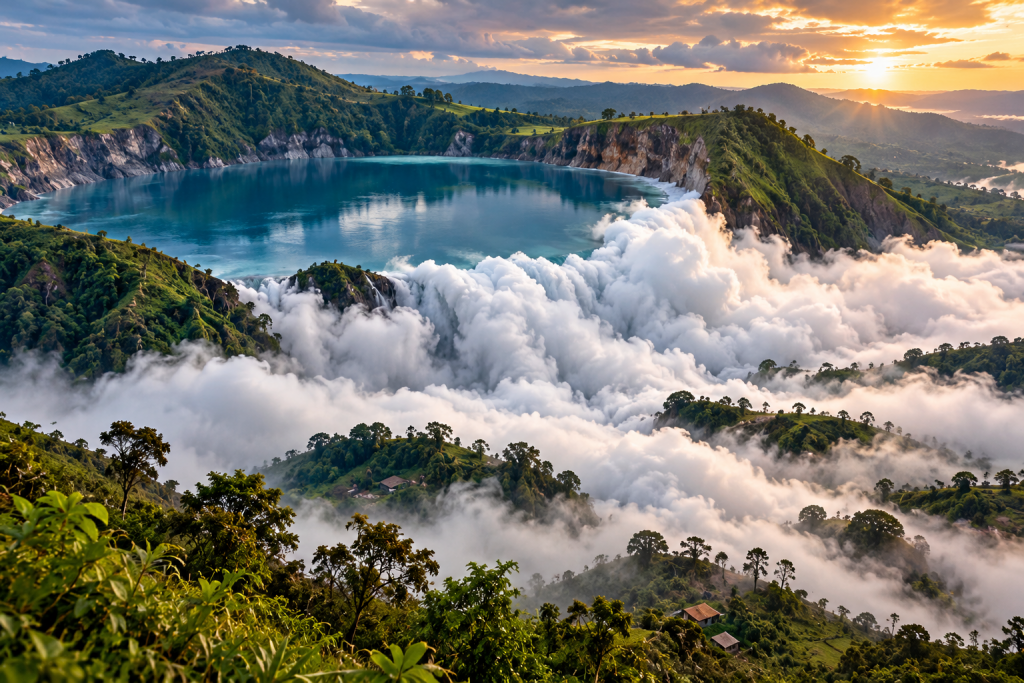
It Sounds Impossible, But It Has Happened
A peaceful lake does not usually look dangerous.
There may be calm water, green hills, farms, villages, and people living nearby.
But under extremely unusual conditions, a lake can hold an enormous amount of dissolved gas beneath its surface.
If that gas suddenly escapes, the results can be deadly.
That is exactly what happened at Lake Nyos in Cameroon in 1986.
The Disaster Began Deep Underwater
Lake Nyos sits in a volcanic region.
Carbon dioxide from below the Earth’s surface can enter the deep water of the lake. Because of the pressure at depth, large amounts of the gas can remain dissolved in the water rather than immediately escaping into the atmosphere.
Over time, that can create a dangerous reservoir of carbon dioxide.
On August 21, 1986, the lake suddenly released an enormous amount of that stored gas. Scientists call this type of event a limnic eruption.
An Invisible Cloud Spilled Out Of The Lake
Carbon dioxide is colorless and odorless.
It is also denser than ordinary air.
After the gas burst from Lake Nyos, it flowed downhill into surrounding low-lying areas.
People could not see a giant approaching cloud or smell something that would warn them to run.
The concentrated carbon dioxide displaced breathable air near the ground. More than 1,700 people died, along with thousands of livestock.
Why Didn’t The Gas Simply Blow Away?
Normally, gases released into the atmosphere disperse.
But the enormous concentration of carbon dioxide and the area’s terrain created an especially dangerous situation.
Because carbon dioxide is heavier than the surrounding air, the gas remained concentrated near the ground as it traveled through valleys and low areas.
NOAA notes that carbon dioxide can collect in depressions and low-lying places when released in sufficiently high concentrations.
Scientists Had To Find A Way To Make The Lake Safer
After the disaster, researchers faced an unusual problem.
The lake could gradually accumulate dangerous quantities of carbon dioxide again.
One solution was to remove the gas in a controlled way rather than allowing pressure to build naturally.
Engineers installed pipes extending deep into Lake Nyos. Gas-rich water is brought upward through the pipes, where decreasing pressure allows carbon dioxide to escape more gradually.
The system essentially gives the lake a controlled way to release some of the gas stored deep below its surface.
Could This Happen At Any Lake?
No.
The circumstances required for this kind of disaster are extremely unusual.
A lake needs the right depth, water structure, source of gas, and environmental conditions for large amounts of dissolved carbon dioxide to accumulate.
Only a small number of lakes are known to present this particular type of hazard.
That rarity is part of what makes the Lake Nyos disaster so extraordinary.
Sometimes The Danger Is Completely Invisible
There was no enormous lava flow racing toward the villages.
There was no towering wave crashing onto shore.
The lake released something people could neither see nor smell.
The tragedy at Lake Nyos became an important scientific lesson about how volcanic gases, deep water, pressure, and geography can combine in a way few people would ever expect.
A lake can look perfectly peaceful on the surface while something very different is happening far below.
And sometimes, the most dangerous thing in sight is the thing you cannot see.
Sources: NOAA, National Weather Service, and scientific reporting on Lake Nyos.