

This Tiny Jellyfish Can Turn Back Its Biological Clock
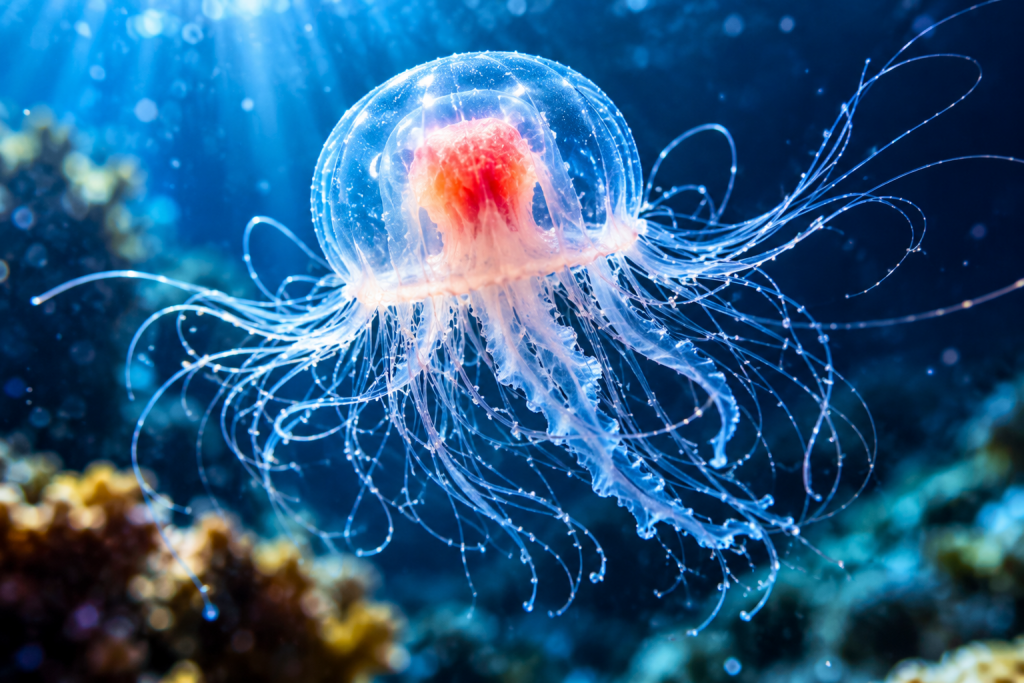
Imagine Growing Old And Then Becoming Young Again
For humans, aging moves in one direction.
We are born, grow older, and eventually die.
But one tiny jellyfish has an extraordinary ability that seems to break that familiar pattern.
Turritopsis dohrnii, commonly called the immortal jellyfish, can reverse its life cycle under certain conditions and return from its adult form to an earlier stage of development. Invasions
It does not travel backward through time.
But biologically, it can do something remarkably close to starting over.
A Jellyfish Normally Has Several Lives In One
The life cycle of a jellyfish is already unusual.
A fertilized egg develops into a tiny swimming larva called a planula. The planula eventually settles onto a surface and develops into a polyp.
Later, polyps produce the free-swimming form most of us recognize as a jellyfish, called a medusa. Smithsonian Ocean
Normally, reaching adulthood would seem like a one-way trip.
Not for Turritopsis dohrnii.
It Can Go Back To An Earlier Stage
When these jellyfish are stressed, injured, or starved, adult medusae can transform into a cyst-like stage and eventually develop into polyps again.
The process involves cellular transformation known as transdifferentiation.
Instead of simply continuing toward death, the animal can effectively restart its life cycle. Invasions
Those new polyps can eventually produce medusae again.
Adult to juvenile.
Then adult again.
At least biologically, the cycle can begin another time.
Does That Mean It Can Never Die?
Not quite.
The nickname immortal jellyfish can be misleading if taken literally.
The animal can still be eaten by predators. It can become diseased. Environmental conditions can kill it.
Its extraordinary ability does not make it indestructible.
What makes the species remarkable is that aging itself does not necessarily force the individual along the usual irreversible path toward the end of its life cycle.
The Smithsonian describes the organism as potentially immortal because of its ability to restart that cycle. Invasions
It Is Surprisingly Tiny
You might expect an animal with such an extraordinary ability to be enormous or intimidating.
It isn’t.
Adult Turritopsis dohrnii medusae are only a few millimeters across. Smithsonian records describe adults measuring roughly 3 millimeters in diameter, although size and appearance can vary among populations. Invasions
An animal smaller than your fingernail possesses one of the strangest life-cycle tricks known in the animal kingdom.
It Has Traveled Far Beyond The Mediterranean
Turritopsis dohrnii was originally described from the Mediterranean.
Scientists have since identified populations in places including Florida, Panama, and Japan.
Research suggests human shipping helped spread the species around the world, possibly through ballast water or by polyps traveling on ships. Invasions
Its ability to survive difficult conditions and reverse its life cycle may have made it a particularly successful ocean traveler.
Scientists Want To Understand How It Works
The jellyfish raises fascinating biological questions.
How can mature cells change their function?
How does an adult organism reorganize itself into an earlier developmental stage?
Researchers continue studying the genetics and cellular biology behind this unusual ability because understanding how organisms control cell identity, repair, and aging could reveal more about fundamental biological processes.
That does not mean scientists have discovered a way to make humans immortal.
The biology of a tiny hydrozoan is vastly different from that of a human being.
Still, nature has demonstrated that at least one animal can perform a trick that once sounded impossible.
Nature Found Its Own Reset Button
The immortal jellyfish does not need a time machine.
When circumstances are right, its own biology provides something almost as strange.
It can leave its adult form behind, return to an earlier stage, and begin the journey toward adulthood again.
For most living creatures, time moves in only one biological direction.
This tiny jellyfish found a way to turn around.
Sources: Smithsonian Ocean and Smithsonian Environmental Research Center. Smithsonian Ocean