

There Is A Village Where People Live Without Roads Or Cars
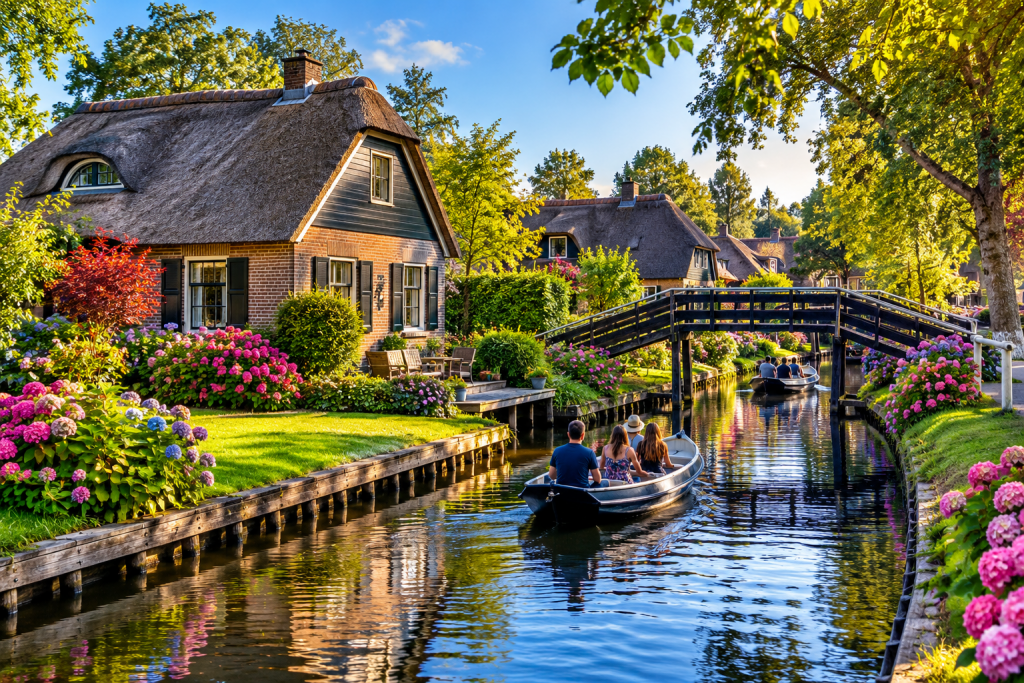
Imagine Leaving Home By Boat Every Day
Most neighborhoods are built around roads.
You walk out your front door, get into a car, ride a bicycle, or follow a sidewalk to wherever you need to go.
But in the Dutch village of Giethoorn, water plays a much bigger role.
The historic center is famous for its canals, wooden bridges, footpaths, and traditional homes built along the waterways.
Some parts of the old village have no conventional roads directly beside the houses.
Instead, residents and visitors move around on foot, by bicycle, and by boat.
The Village Grew Around Water
Giethoorn is located in the province of Overijssel in the Netherlands.
Its unusual landscape developed partly because people excavated peat from the surrounding wetlands.
Digging out peat created pits and channels that gradually helped shape the watery landscape for which the area is now famous.
Over time, canals became an important part of local transportation.
The result looks like something from a storybook.
Homes sit beside narrow waterways.
Small bridges connect properties.
Boats glide quietly between gardens and cottages.
There Are Bridges Everywhere
One of Giethoorn’s most recognizable features is its collection of small bridges.
The village has more than 170 bridges, according to Guinness World Records.
Many cross the canals to connect homes and walking paths.
Instead of seeing driveways leading from houses to streets, you may see a bridge crossing a canal.
That simple difference completely changes the appearance of the neighborhood.
People Still Have Cars
Giethoorn is sometimes described online as a village with absolutely no roads or cars.
That is an exaggeration.
Modern roads and parking areas exist around the village, and residents certainly can own cars.
The unusual feature is the historic center, where canals and paths dominate and many homes are not directly reached by ordinary streets.
Once visitors enter those sections, walking and boating become much more important.
So Giethoorn is not an isolated community that has somehow banned automobiles.
It is a real modern village that preserved an extraordinary historic layout.
Even Deliveries Can Involve Boats
Life beside canals changes ordinary activities.
Boats can be used to transport goods, maintain properties, and move around sections of the village.
Traditional vessels known as punters were historically used in the area. These long, narrow boats could be propelled using a pole in the shallow waterways.
Today, quiet electric boats are common, especially among visitors exploring the canals.
The slow movement of boats is part of what gives the historic village its peaceful atmosphere.
It Has Become Famous Around The World
Not surprisingly, Giethoorn attracts large numbers of tourists.
Photographs of its cottages, gardens, bridges, and canals have spread widely online.
It is sometimes nicknamed the “Venice of the Netherlands.”
The comparison is understandable, but Giethoorn has its own personality.
Instead of grand stone buildings and busy urban canals, much of the historic village feels rural and green.
Reeds grow beside the waterways.
Gardens surround traditional homes.
Small bridges arch over narrow canals.
A Different Way To Build A Neighborhood
Giethoorn is a reminder that cities and towns do not all have to develop around automobiles.
For centuries, geography, local resources, and transportation needs shaped communities in very different ways.
In this Dutch village, water became part of the neighborhood itself.
You can step outside, cross a little bridge, follow a footpath, or climb aboard a boat.
For residents of many places, a canal would be something separating one neighborhood from another.
In Giethoorn, the canal is part of the neighborhood.
Sources: Guinness World Records and historical and tourism information about Giethoorn.