

Antarctica Has A Waterfall That Looks Like It Is Bleeding
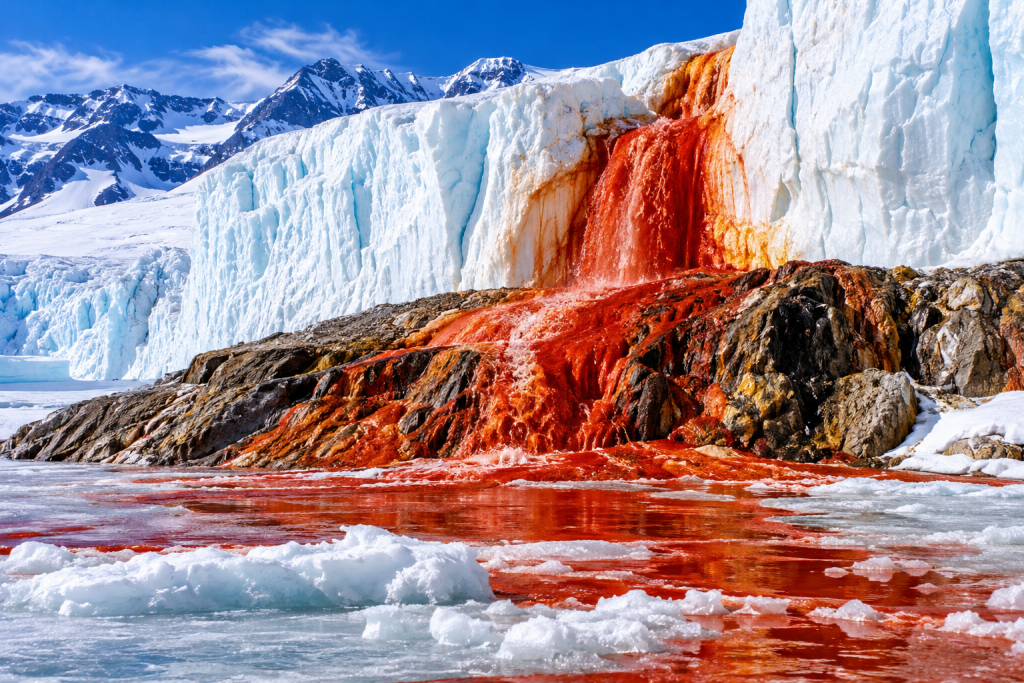
A Red Stain Across A White Glacier
Antarctica is a landscape we associate with white ice, blue glaciers, and endless snow.
Then there is Blood Falls.
At the end of Taylor Glacier in Antarctica’s McMurdo Dry Valleys, a startling reddish liquid periodically emerges from the glacier and stains the ice below.
Against the nearly white surroundings, it can look disturbingly like blood pouring from the glacier.
But there is no blood involved.
The real explanation is arguably even more interesting. NSF – U.S. National Science Foundation
The Red Color Comes From Iron
Blood Falls is fed by extremely salty, iron-rich water called brine.
The brine travels from beneath and within Taylor Glacier before occasionally emerging through cracks near its terminus. NSF Pubs
When iron in the brine reaches the surface and encounters oxygen, chemical reactions involving the iron produce the rusty red material that gives Blood Falls its unmistakable appearance. NSF – U.S. National Science Foundation
It is somewhat similar to the process that gives ordinary rust its reddish color.
The Water Has Been Hidden Beneath The Ice
The source of the brine is not a little red lake sitting directly behind the waterfall.
Radar observations indicate that the brine system extends beneath Taylor Glacier, with a source located miles up-glacier from Blood Falls. NSF – U.S. National Science Foundation
Research indicates that the salty water has a marine history and has been chemically altered during its long isolation beneath the glacier. NSF Pubs
The National Science Foundation says the Blood Falls system may be ancient, potentially dating to around the time of a major advance of Taylor Glacier roughly 1.5 million years ago. NSF – U.S. National Science Foundation
Why Doesn’t The Water Freeze Solid?
This is another strange part of the story.
Antarctica is obviously cold enough to freeze ordinary water.
But Blood Falls contains extremely high concentrations of dissolved salts.
Salt lowers the freezing point of water, helping the brine remain liquid at temperatures where fresh water would freeze.
That allows liquid water to persist inside an environment dominated by ice.
Something Is Living Down There
Perhaps the most extraordinary discovery is that this hidden environment is not lifeless.
Scientists have detected microorganisms associated with the brine system.
These organisms survive in conditions that sound extraordinarily hostile.
They live in darkness.
They endure extreme cold and high salinity.
And because sunlight cannot reach them beneath the glacier, they cannot depend on photosynthesis in the way many surface ecosystems do.
Instead, microbes in this environment can obtain energy through chemical processes involving materials available beneath the glacier. NSF – U.S. National Science Foundation
Scientists Still Have Questions About The Falls
Researchers understand where the red color comes from and know that hypersaline brine is responsible for the flow.
But one mystery remains.
Exactly what triggers individual releases of brine is still not completely understood.
Researchers have documented Blood Falls flowing even during the Antarctic winter, when surface melting cannot explain the release.
A study using time-lapse photography captured a winter discharge but found no obvious increase in seismic activity that would neatly explain what triggered it. NSF Pubs
So Blood Falls has surrendered some of its secrets while keeping others.
It Could Teach Us About Life On Other Worlds
Blood Falls is more than an Antarctic curiosity.
Scientists are interested in places like this because they demonstrate that life can survive in cold, dark, salty environments isolated beneath ice.
The National Science Foundation specifically notes that Blood Falls can help researchers ask questions relevant to the possibility of life in icy environments beyond Earth, including Mars. NSF – U.S. National Science Foundation
Other icy worlds in our solar system may also contain liquid water beneath frozen surfaces.
If microorganisms can survive beneath Antarctic ice, scientists naturally want to understand how they do it.
Antarctica’s Bleeding Glacier Is Very Much Alive
From a distance, Blood Falls looks like something terrible happened on the ice.
Up close, its story is completely different.
The red is iron.
The liquid is ancient salty brine.
And hidden beneath the frozen landscape is an ecosystem containing microscopic life.
A glacier that appears to be bleeding turns out to be a window into a world humans normally cannot see.
Sometimes the explanation behind something strange is even stranger than the thing itself.
Sources: U.S. National Science Foundation and peer-reviewed research on Taylor Glacier and Blood Falls.