

People Have Lived In Homes Carved Into Rock For Thousands Of Years
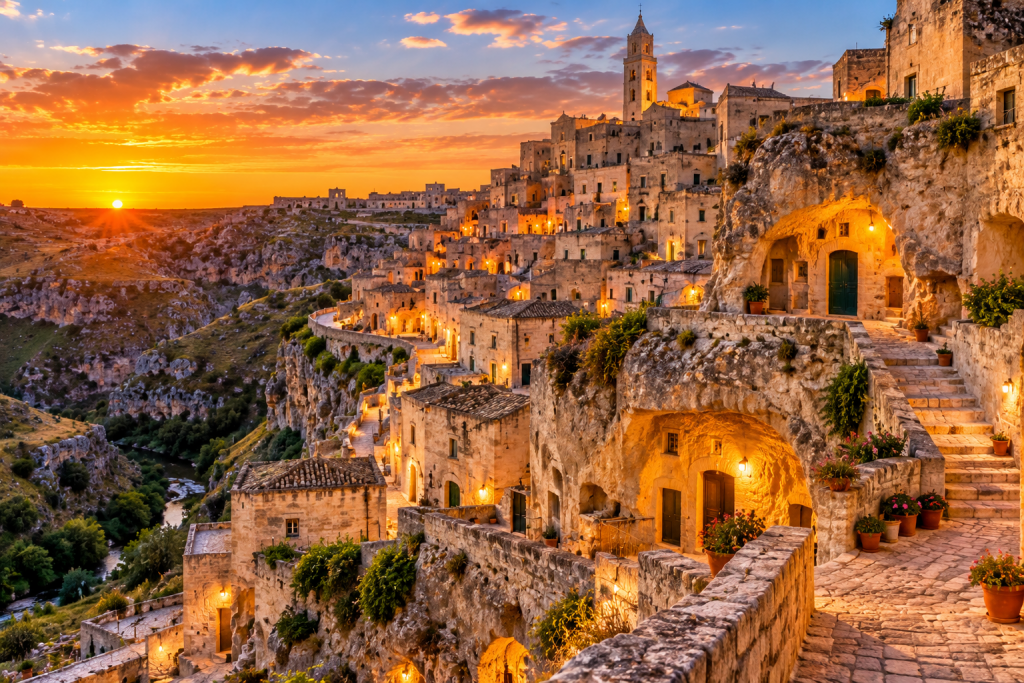
A City That Seems To Grow Out Of The Stone
In southern Italy is a city unlike almost anywhere else.
Walk through Matera, and you will see houses, churches, stairways, courtyards, and narrow passages blending directly into pale limestone cliffs.
Some buildings appear conventional from the outside.
Step inside, however, and part of the home may extend directly into the rock.
These ancient neighborhoods are known as the Sassi di Matera, or the Stones of Matera. UNESCO recognizes the area as an extraordinary example of a settlement that developed in close relationship with its natural environment.
People Have Lived In The Area Since Prehistoric Times
Matera’s history stretches remarkably far into the past.
Archaeological evidence shows human occupation in the area dating back thousands of years, with UNESCO describing the region as having evidence of human settlement from the Palaeolithic period.
Over generations, people expanded natural caves and carved additional rooms into the soft limestone.
The landscape gradually became a complicated mixture of natural rock and human construction.
Instead of simply building on the land, residents built into it.
A Roof Could Become Someone Else’s Street
The Sassi developed along steep slopes.
Because homes were constructed at different levels, the roof of one building could become a pathway, courtyard, or foundation for another structure above it.
Staircases twist between homes.
Alleys disappear beneath arches.
Caves extend behind stone facades.
From a distance, the buildings seem stacked on top of one another as they descend toward the ravine below.
The entire neighborhood became almost like a three-dimensional puzzle.
They Developed An Ingenious Way To Collect Water
Living in a rocky environment presented a major challenge.
Water.
Residents created an elaborate system of channels, cisterns, and underground storage spaces designed to capture and preserve rainwater.
UNESCO specifically highlights Matera’s sophisticated water-management system as an important part of the settlement’s adaptation to its environment.
Rain falling onto roofs and courtyards could be directed through channels into cisterns carved into the rock.
Even something as simple as the shape of a street could become part of the city’s water system.
Life There Eventually Became Extremely Difficult
Matera’s history is not entirely romantic.
By the 20th century, severe overcrowding and poverty had created terrible living conditions in parts of the Sassi.
Families sometimes shared small cave dwellings with livestock, while sanitation and access to clean water were inadequate.
In the 1950s, the Italian government relocated thousands of residents from the Sassi into newer housing.
For a time, much of the ancient district was largely abandoned.
Then The Ancient Neighborhood Came Back To Life
Decades later, attitudes toward the Sassi began to change.
Restoration projects transformed many of the old structures while preserving their historic character.
Matera was added to the UNESCO World Heritage List in 1993.
Today, restored cave structures contain homes, hotels, restaurants, museums, and businesses.
Matera was also selected as a European Capital of Culture for 2019, bringing even greater international attention to the city.
Even The Churches Were Carved Into Stone
Homes are not the only structures hidden inside Matera’s rock.
The area contains numerous rock-cut churches, some decorated with centuries-old religious paintings.
Rather than constructing an entire church from blocks of stone, builders could excavate spaces directly into the limestone.
The result is architecture that sometimes feels less like something humans built and more like something they uncovered.
A City Built With The Earth Instead Of On Top Of It
Modern cities often transform the landscape to make room for buildings.
Matera followed a very different path.
Its residents adapted themselves to the landscape.
They carved rooms into cliffs.
They captured rainwater underground.
They stacked homes along steep slopes.
And they created neighborhoods where the boundary between architecture and geology almost disappears.
Thousands of years later, people are still walking through the same rocky landscape.
In Matera, the mountain did not simply hold the city. Part of the mountain became the city.
Sources: UNESCO World Heritage Centre and European cultural heritage sources.