

The World’s Largest Known Living Organism Is Hiding Underground
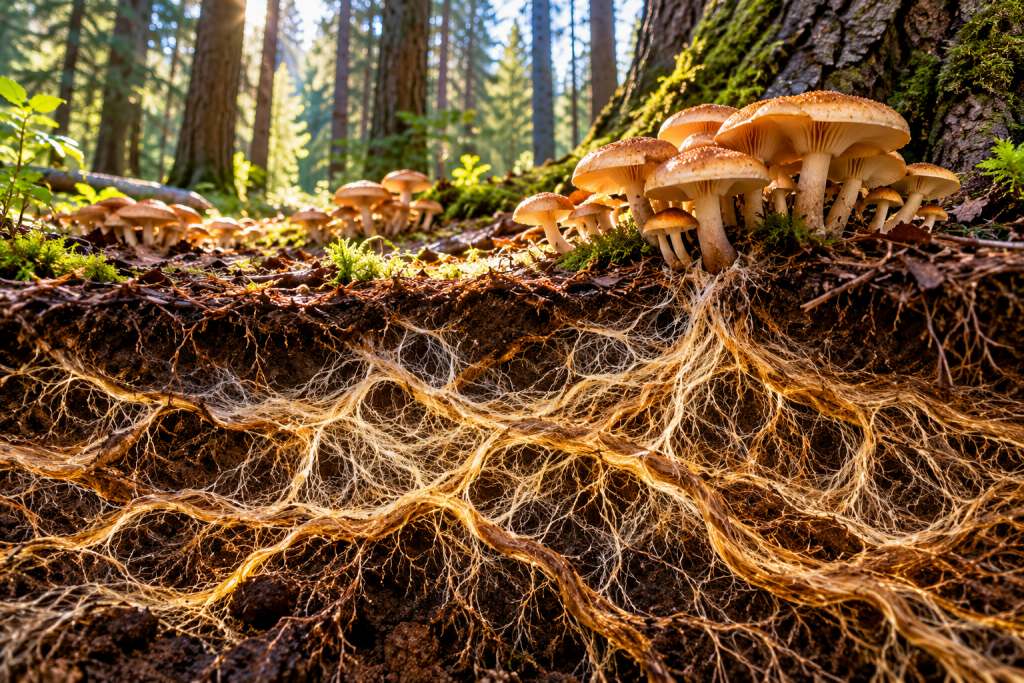
You Could Walk Over It And Never Know
If someone asked you to picture the largest known living organism on Earth, you might imagine a blue whale or an enormous tree.
You probably would not picture a fungus hiding beneath an Oregon forest.
Yet beneath the trees of Malheur National Forest lives an enormous individual fungus known popularly as the Humongous Fungus.
The organism belongs to the Armillaria group of fungi. Older sources identify it as Armillaria ostoyae, while current U.S. Forest Service material uses the name Armillaria solidipes. US Forest Service
It Covers Thousands Of Acres
This fungus is not simply a particularly large mushroom.
Most of the organism exists underground, spreading through soil and tree roots as a vast network.
Forest Service research measured the famous individual at approximately 965 hectares, or about 2,385 acres. That is more than three square miles. USFS Research & Development
The Forest Service has described it as the largest known living organism by biomass. Estimates in one agency publication put its mass somewhere between 7,567 and 35,000 tons. US Forest Service
How Can One Fungus Become So Huge?
What looks like separate patches of fungus can actually belong to the same genetic individual.
Scientists tested fungal samples from different locations in the forest and determined that samples spread across an enormous area belonged to the same genet, meaning they were part of one genetically identical individual. USFS Research & Development
Armillaria can spread underground through roots and structures called rhizomorphs.
These dark, cord-like structures can move through soil and help the fungus reach new roots. Oregon State University explains that root contacts, root grafts, and rhizomorphs all help Armillaria spread below ground. OSU Extension Service
It May Be Thousands Of Years Old
Its size is not the only astonishing thing about it.
Scientists have estimated the age of the Oregon fungus by considering its enormous size and possible rates of underground growth.
Depending on the growth rate used, estimates range from approximately 1,900 to 8,650 years. USFS Research & Development
That means portions of this organism may have been growing beneath the forest since long before many civilizations familiar to us today existed.
But It Is Not Harmless
The Humongous Fungus sounds almost cute until you learn what it does.
Armillaria causes root disease in trees. It can colonize and decay root systems, weaken trees, and eventually kill them.
In affected forests, the disease can create areas filled with declining or dead trees as the fungus slowly expands underground. US Forest Service
Even after trees die, the fungus can persist in woody material for years. US Forest Service
The Mushrooms Are Only A Tiny Part Of The Story
When most of us hear the word fungus, we picture mushrooms popping out of the ground.
But a mushroom is only a reproductive structure produced by a much larger fungal organism.
That is what makes the Oregon giant so fascinating. You cannot simply stand at one end and look across its entire body.
Much of it is concealed beneath the forest floor and inside roots.
Above ground, you see trees, soil, fallen wood, and occasionally mushrooms.
Below ground is something enormous.
A Giant Hiding In Plain Sight
There are animals larger than houses and trees tall enough to tower over skyscrapers.
But one of Earth’s most extraordinary living giants does not need to stand above the landscape at all.
It quietly spreads beneath it.
Thousands of acres of forest can sit above a single fungal individual while people walk through the area without ever realizing what lies underneath their feet.
Sometimes the strangest things on Earth are not difficult to find because they are far away.
They are difficult to find because they are hidden right beneath us.
Sources: U.S. Forest Service and Oregon State University.