

An Octopus Has Three Hearts And Blue Blood
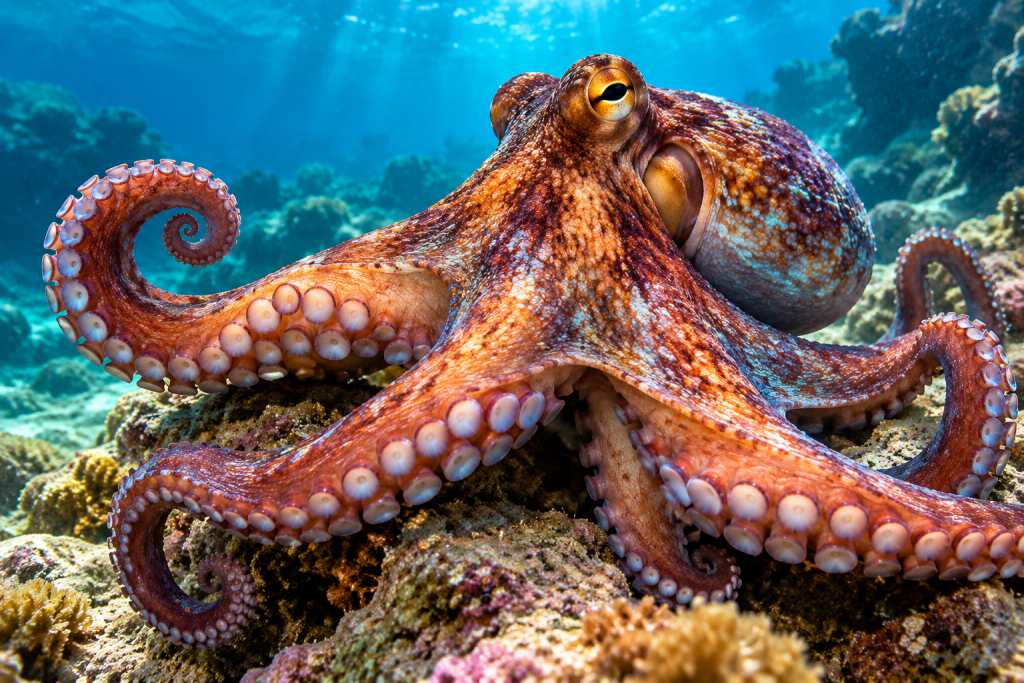
An Animal That Sounds Almost Alien
Eight arms, three hearts, blue blood, a soft body that can squeeze through tiny openings, and skin capable of changing appearance.
It sounds like something invented for a science fiction movie.
But it is an octopus.
Octopuses are members of a group of marine animals called cephalopods, which also includes squid and cuttlefish. Their unusual anatomy is one of the reasons scientists and ocean lovers find them so fascinating. Smithsonian Ocean
Why Does An Octopus Need Three Hearts?
An octopus does not have just one heart like a human.
It has three.
Two of the hearts, called branchial hearts, pump oxygen-depleted blood through the gills.
The third, called the systemic heart, pumps oxygen-rich blood throughout the rest of the body. Smithsonian Ocean
Three hearts may sound excessive to us, but they are part of the octopus’s specialized circulatory system.
And the hearts are not even the strangest part.
Its Blood Really Is Blue
Human blood gets its red color largely from hemoglobin, an iron-containing protein that transports oxygen.
Cephalopods use a different oxygen-carrying molecule called hemocyanin.
Hemocyanin contains copper, which gives oxygenated cephalopod blood its distinctive blue appearance. Smithsonian Ocean
So when someone says an octopus has blue blood, it is not just a colorful expression.
It really does.
Its Skin Is An Incredible Disguise
Octopuses can perform another remarkable trick.
They can rapidly change the appearance of their skin.
Thousands of specialized pigment cells called chromatophores help produce changes in color. Other structures can reflect light, while some octopuses can even alter the texture of their skin to resemble rocks, coral, or other parts of their surroundings. Smithsonian Ocean
This camouflage can help an octopus hide from predators or approach prey without being easily noticed.
Some species are so effective at disappearing into their surroundings that you could be staring directly at one and still struggle to see it.
Their Arms Can Taste And Smell Their Surroundings
Those famous suckers are much more sophisticated than simple suction cups.
Octopus suckers contain sensory receptors that help the animal detect chemicals and textures as it explores its environment.
In other words, an octopus can gather information about what it is touching while moving its arms across rocks, sand, and potential food. Monterey Bay Aquarium
For an octopus, reaching out to touch something provides an extraordinary amount of information about the world around it.
They Are Surprisingly Intelligent
Octopuses have also developed a reputation for remarkable problem-solving abilities.
The Monterey Bay Aquarium describes giant Pacific octopuses as capable of solving mazes and recognizing aquarists. Researchers have long studied cephalopods because their sophisticated behavior evolved very differently from intelligence in vertebrate animals such as mammals and birds. Monterey Bay Aquarium
That makes the octopus especially interesting.
Its evolutionary path is very different from ours, yet it developed complex behaviors and impressive ways of interacting with its environment.
One Of The Strangest Animals In The Ocean
Three hearts.
Blue blood.
Eight flexible arms lined with highly sensitive suckers.
Skin that can transform its appearance.
And impressive problem-solving abilities packed inside an animal with no backbone.
The deeper we look into the ocean, the easier it becomes to understand why some of Earth’s real creatures can seem stranger than anything humans could invent.
And the octopus may be one of the best examples of all.
Sources: Smithsonian Ocean and Monterey Bay Aquarium.