

Your Brain Can Start Cleaning Itself While You Sleep
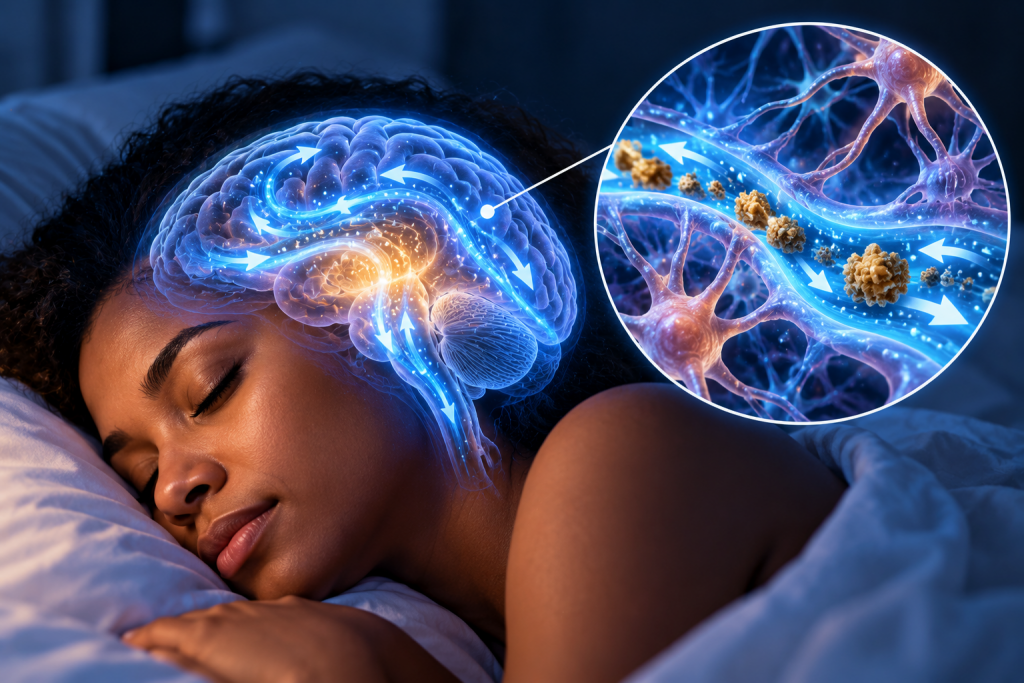
Sleep Is Not Just Your Brain Turning Off
When you fall asleep, it may feel as though your brain simply shuts down for the night.
It does not.
Your brain remains remarkably active while you sleep. It organizes information, supports memory and performs important maintenance.
One particularly fascinating area of research involves the movement of fluid through and around the brain and the removal of metabolic waste.
Scientists often discuss this process as part of the brain’s glymphatic system.
The Brain Produces Waste Too
Every active cell produces waste products.
Brain cells are no exception.
As neurons and other cells perform their normal functions, metabolic byproducts accumulate in the surrounding environment.
The brain therefore needs ways to move substances through its tissues and eventually clear unwanted material.
Researchers have found that cerebrospinal fluid, the clear liquid surrounding the brain and spinal cord, plays an important role in this process.
Sleep Appears To Change How Fluid Moves Through The Brain
One of the discoveries that made this subject famous came from experiments in mice.
Researchers reported that the space between brain cells increased during sleep or anesthesia, allowing cerebrospinal fluid to move more readily through brain tissue.
Waste clearance was also more efficient during sleep in those experiments.
The findings raised an intriguing possibility.
One reason animals need sleep may be to give the brain an opportunity to perform maintenance that is more difficult while awake.
Scientists Have Seen Rhythms In Sleeping Human Brains
Researchers have also observed fascinating changes in humans during sleep.
A study published in Science found large waves of cerebrospinal fluid moving through the brain during non-REM sleep.
Those fluid waves occurred alongside slow electrical activity in the brain and changes in blood flow.
Rather than being completely quiet, the sleeping brain appeared to be cycling through coordinated electrical, blood-flow and fluid changes.
Is It Literally Washing Your Brain?
Not exactly.
The phrase “brain washing itself” is a useful way to picture the process, but your brain is not being scrubbed like a dish.
The biology is far more complicated.
Scientists are still studying precisely how cerebrospinal fluid moves through human brain tissue, how important the glymphatic pathway is compared with other clearance mechanisms, and how sleep affects those systems.
Some aspects that are well established in animal experiments are harder to measure directly in living humans.
So the science is exciting, but researchers are still filling in important pieces.
Why Scientists Care About This System
Researchers are especially interested in brain waste clearance because certain proteins can accumulate in neurological diseases.
For example, amyloid-beta is associated with Alzheimer’s disease.
Animal studies have shown that sleep can influence the clearance of molecules including amyloid-beta from brain tissue.
That does not mean sleeping more can prevent or cure Alzheimer’s disease.
It does mean that understanding how sleep and brain clearance interact could help scientists better understand normal brain health and disease.
Your Brain Has A Night Shift
We often treat sleep as the part of the day when nothing is happening.
But inside your head, an extraordinary amount of activity continues.
Neurons change their firing patterns.
Memories are processed.
Blood flow changes.
Cerebrospinal fluid moves in rhythmic patterns.
And systems involved in clearing metabolic waste continue doing their work.
You may be unconscious.
Your brain’s night shift is still very much awake.
Sources: National Institutes of Health and peer-reviewed research published in Science.