

Trees Can Be Connected By Hidden Fungal Networks Underground
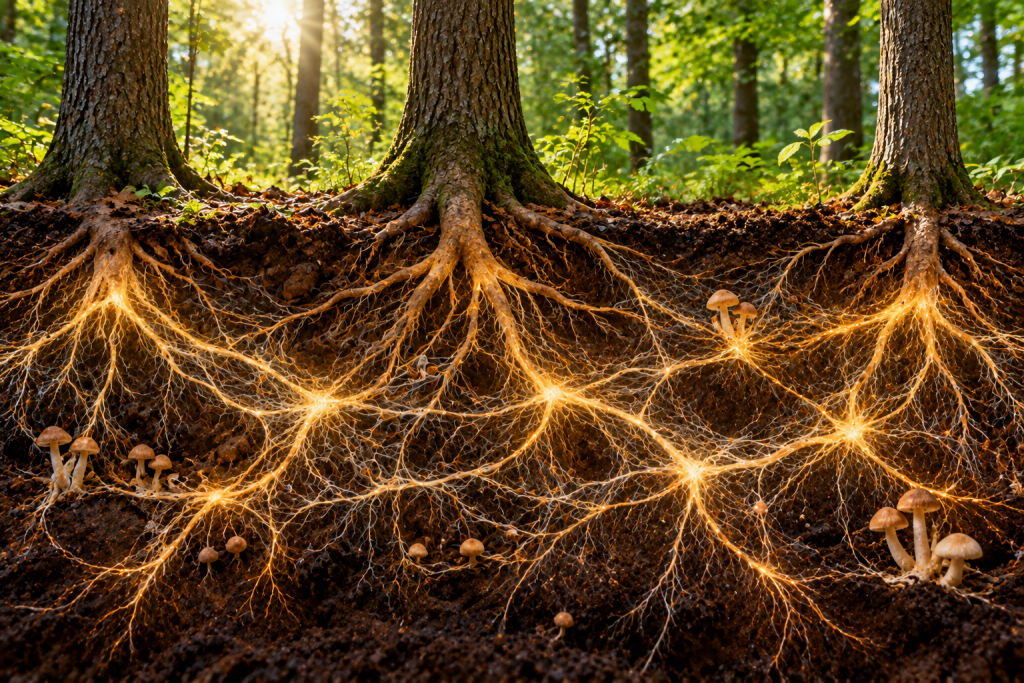
There Is Another World Beneath A Forest
Walk through a forest and most of what you notice is above ground.
Trunks.
Branches.
Leaves.
But underneath your feet, tree roots can form close partnerships with microscopic fungal threads spreading through the soil.
These relationships are called mycorrhizae.
In some cases, fungal networks can connect the roots of more than one plant, creating what scientists call common mycorrhizal networks. ScienceDirect
The phenomenon has become popularly known as the “wood-wide web.”
Trees And Fungi Make A Trade
The relationship begins with an exchange.
Trees produce sugars and other carbon compounds through photosynthesis.
Fungi cannot photosynthesize, so they can receive carbon from their plant partners.
In return, mycorrhizal fungi can help plants obtain resources from the soil, including nutrients such as nitrogen and phosphorus, and can contribute to water uptake. ScienceDirect
The fungal threads are extremely thin and can explore areas of soil beyond the reach of a tree’s roots.
For both organisms, the partnership can be valuable.
One Fungus Can Connect Multiple Plants
Here is where the story becomes especially interesting.
A fungal mycelium can associate with the roots of multiple plants.
That means separate plants can become physically linked through fungal tissue beneath the ground. ScienceDirect
Experiments have also found movement of carbon and other materials between plants associated with these networks.
One study found belowground carbon transfer between pine and oak trees mediated by ectomycorrhizal fungi. Nature
Earlier field research also detected carbon transfer between tree species connected with ectomycorrhizal fungi. Nature
But Are The Trees Actually Talking?
This is where we need to be careful.
You may have heard that forests operate almost like the internet, with trees deliberately sending food and warning messages to one another.
That makes a wonderful story.
The scientific reality is more complicated.
Researchers agree that mycorrhizal relationships are extremely important, and there is evidence for transfers of resources and chemical signals in certain circumstances.
But scientists have challenged some of the stronger claims made about the “wood-wide web.” Nature
A 2023 review in Nature Ecology & Evolution concluded that claims about how widespread these networks are in forests and how much they improve seedling performance had sometimes gone beyond the available evidence. Nature
So saying trees are having conversations underground would be too simple.
Scientists Are Still Debating What The Networks Do
This is what makes the subject so interesting.
The underground connections are real.
The partnerships between trees and fungi are real.
Transfers of materials through fungal associations have been demonstrated. Nature
But exactly how important these networks are across different forests, how frequently resources move between plants through them, and whether some popular interpretations accurately describe what is happening remain active scientific questions.
A 2026 Nature Chemistry article described the underground world as complex and emphasized that scientists still have much to learn about plant-fungus interactions. Nature
A Forest Is More Connected Than It Looks
Above ground, a tree may appear to be an individual organism standing alone.
Below ground, the picture can be very different.
Roots interact with fungi.
Fungi spread through soil.
Some fungal networks connect multiple plants.
Water, nutrients, carbon compounds, and chemical signals can move through this complicated underground environment. ScienceDirect
Scientists are still determining exactly what all those connections mean.
But one thing is clear.
When you walk through a forest, you are seeing only half of it.
Some of the most fascinating activity is happening in the darkness beneath your feet.
Sources: Nature, Nature Ecology & Evolution, The ISME Journal, and scientific reviews of mycorrhizal networks.