

There Are Lakes And Rivers At The Bottom Of The Ocean
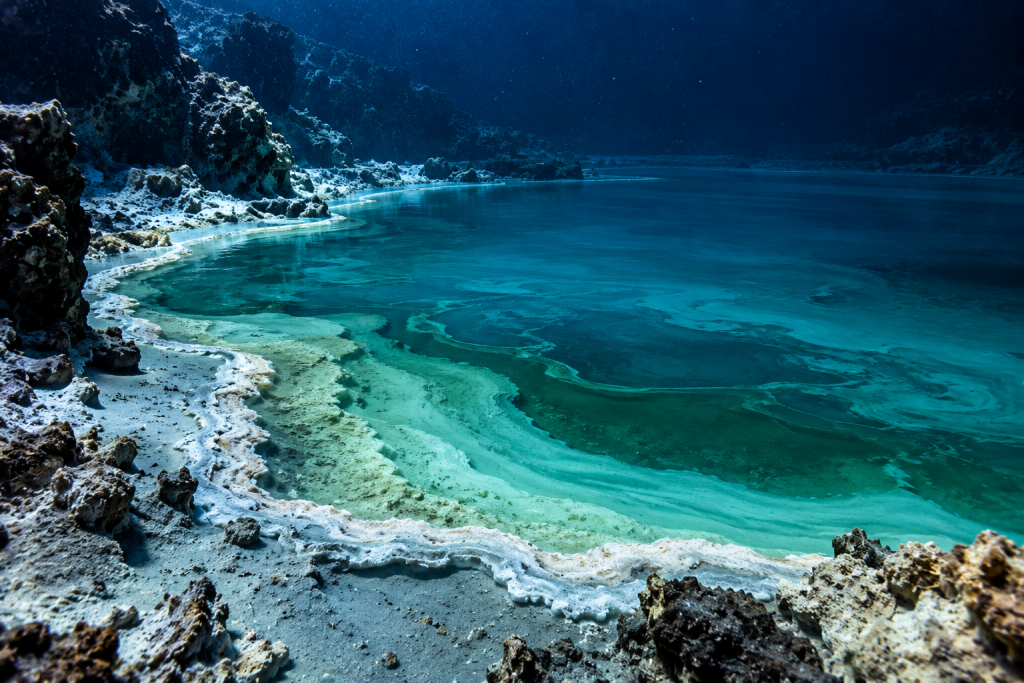
A Lake Beneath The Sea Sounds Impossible
Imagine descending thousands of feet into the ocean.
You reach the seafloor, but instead of seeing only rocks, sand, and marine life, you encounter what appears to be a lake.
It has a visible shoreline.
Its surface can ripple.
In some places, dense liquid even appears to flow along the bottom like an underwater river.
These strange formations are real.
They are known as brine pools, and they are among the most unusual environments found in the deep ocean.
How Can Water Exist Inside Water?
The answer is salt.
Brine pools contain water with an extremely high concentration of dissolved salt.
That brine can be much denser than the seawater surrounding it.
Instead of immediately mixing with the ocean above, the heavier brine settles into depressions on the seafloor.
The boundary between ordinary seawater and the dense brine can become so distinct that it resembles the surface of a lake.
Some Even Have Shorelines
This is where things become especially strange.
Sediments can collect around the edges of brine pools, creating features that look remarkably similar to shorelines.
Researchers exploring these environments with remotely operated vehicles have recorded pools with clearly defined boundaries.
From the camera’s perspective, it can look as though the vehicle has discovered a lake at the bottom of another, vastly larger body of water.
Except the “air” above this lake is seawater.
Underwater Rivers Can Form Too
Dense brine does not always remain trapped in one location.
When it moves downhill across the seafloor, it can behave somewhat like a river.
Scientists have documented brine flowing through channels and basins beneath the ocean.
The basic principle is similar to oil settling beneath water in a container. The liquids have different densities, allowing one layer to remain distinguishable from another.
In the deep sea, however, the effect can happen on a far larger scale.
These Pools Can Be Deadly
Some brine pools are extremely hostile environments.
The water can contain very little oxygen and high concentrations of chemicals such as hydrogen sulfide or methane.
Animals that accidentally enter certain pools may become stunned or die.
That has led to dramatic nicknames such as “jacuzzi of despair” for particularly inhospitable brine pools discovered in the Gulf of Mexico.
But that does not mean nothing can live there.
Strange Life Thrives Around Them
The edges of some brine pools support communities of organisms adapted to conditions that would be dangerous to many other forms of life.
Microbes can use chemicals such as methane and hydrogen sulfide as energy sources.
Those microbes can support larger ecosystems that include mussels, tube worms, and other animals living near the pools.
Instead of depending directly on sunlight, these communities can be powered by chemical energy.
That makes them especially interesting to scientists studying extreme environments.
They May Help Us Think About Life Beyond Earth
Extreme environments on Earth give researchers clues about where life might survive elsewhere.
Scientists studying organisms that tolerate intense salinity, darkness, pressure, and unusual chemistry can learn more about the limits of life.
That is especially intriguing when considering worlds in our solar system believed to contain oceans beneath icy surfaces.
Earth’s strangest environments sometimes become natural laboratories for asking a much bigger question.
Where else could life exist?
An Ocean Hidden Inside An Ocean
We tend to think of the seafloor as the bottom of the story.
But Earth’s oceans continue to surprise us.
Far below the waves are pools with their own visible surfaces, dense liquid flowing through underwater channels, and organisms surviving in conditions that seem almost impossible.
There are places where you can descend through miles of water only to arrive at something that looks remarkably familiar.
Another lake waiting at the bottom.
Sources: NOAA Ocean Exploration and peer-reviewed deep-sea research.