

Rocks In Death Valley Can Move Across The Ground By Themselves
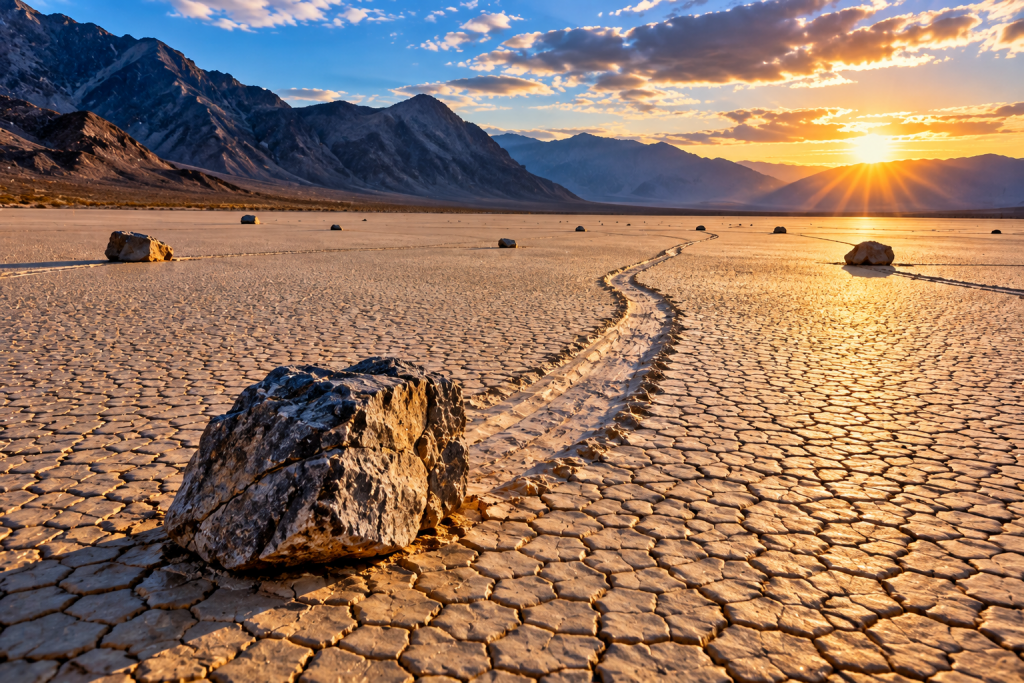
The Rocks Leave Trails Behind Them
In a remote part of Death Valley National Park is a dry lakebed called Racetrack Playa.
Scattered across its remarkably flat surface are rocks of different sizes.
Nothing strange about that.
Until you look behind them.
Many of the rocks have long trails carved into the playa, making it appear as though someone dragged them across the desert.
Some trails stretch for hundreds of meters, and some of the rocks weigh as much as 700 pounds. National Park Service
There was just one problem.
For decades, nobody actually saw them move.
The Mystery Lasted For Generations
Scientists studied the moving rocks for years.
Wind was suspected. So was slippery mud.
Other explanations involved algae, dust devils, and thick sheets of ice.
USGS researchers mapped more than 160 sliding rocks and their trails in the 1990s, but at the time the exact mechanism remained unresolved. USGS
Then researchers decided to watch the playa more closely.
They installed a weather station and placed specially prepared rocks containing GPS equipment on the lakebed.
And they waited.
Then The Desert Filled With Water
In December 2013, researchers arrived to find something unusual.
A shallow pond had formed across part of Racetrack Playa.
During cold nights, the surface froze.
But this was not thick ice.
The pond produced extremely thin sheets of what researchers described as windowpane ice. National Park Service
When the sun came out, the ice began breaking into large floating panels.
Then the wind started blowing.
And finally, scientists saw something people had wondered about for decades.
The rocks began to move.
Thin Ice Was Pushing Them
Light winds pushed the floating sheets of ice across the shallow water.
Those sheets pressed against rocks sticking above the surface and slowly pushed them across the soft mud underneath.
The rocks were not racing.
Researchers measured speeds of only about 2 to 6 meters per minute.
Some moved for just seconds, while others continued for as long as 16 minutes. National Park Service
At that speed, someone standing far away might not even notice the movement.
Rocks Far Apart Moved Together
One observation was especially remarkable.
Researchers saw rocks separated by the length of several football fields begin moving at approximately the same time.
Some traveled more than 200 feet before stopping. National Park Service
The ice sheets could push many rocks during the same event, helping explain why trails across the playa sometimes appear to follow similar directions.
It Takes A Rare Combination Of Conditions
The reason people almost never saw the rocks moving is that several things have to happen together.
Water must collect on the normally dry playa.
Temperatures must become cold enough for that water to freeze.
The ice must be thin enough to move but strong enough to push against rocks.
Then the sun must begin melting it while enough wind blows across the surface.
Those conditions do not happen every day in Death Valley.
The rocks can remain still for years. National Park Service
The Tracks Are Still Amazing To See
Today, visitors can see rocks and their mysterious-looking trails across Racetrack Playa.
The National Park Service warns visitors not to move the stones or walk on the playa when it is wet because footprints and vehicle tracks can damage the fragile surface and remain visible for years. National Park Service
So the rocks should be left exactly where nature puts them.
One Mystery Finally Caught In The Act
For years, Death Valley’s sailing stones looked almost supernatural.
Huge rocks sat in the desert with trails stretching behind them, yet no one seemed to catch them moving.
The explanation turned out to require no invisible force.
Just water, freezing nights, sunshine, thin floating ice, and a little wind.
But knowing the explanation does not make the sight any less strange.
In one of the hottest places on Earth, ice helps rocks sail across the desert. National Park Service
Sources: U.S. National Park Service and U.S. Geological Survey.