

Some Planets Wander Through Space Without A Sun
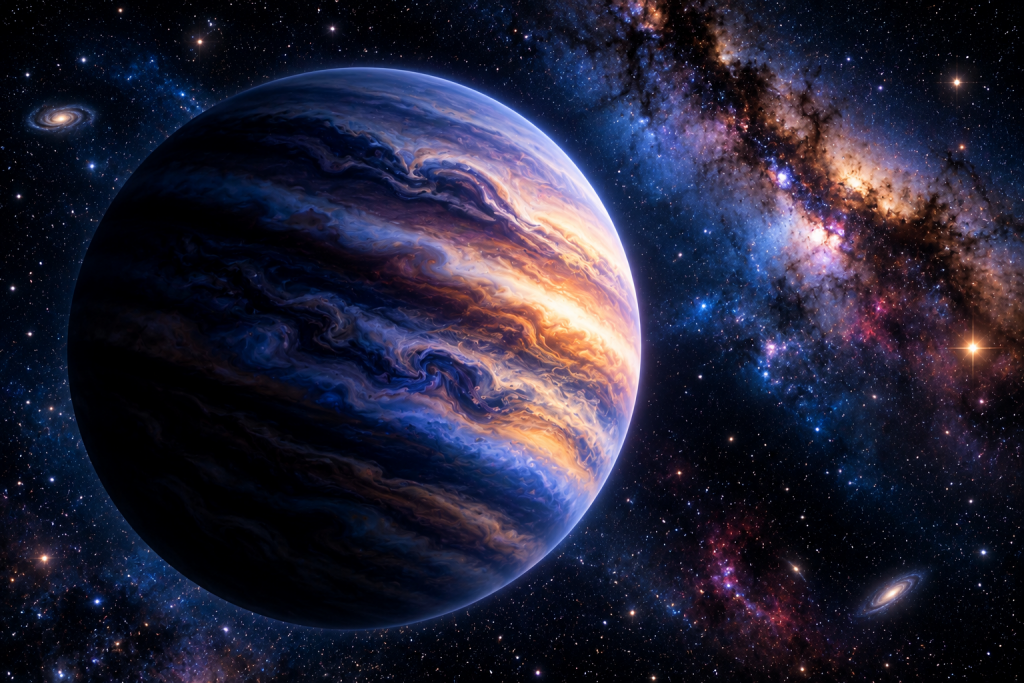
A World With No Sunrise
When we picture a planet, we usually picture it orbiting a star.
Earth circles the Sun. Jupiter circles the Sun. Thousands of known planets beyond our solar system orbit other stars.
But astronomers have also found strange planetary-mass worlds traveling through space without being bound to any star.
They are often called rogue planets or free-floating planets. NASA Science
They Really Are Out There
This is not just an astronomical theory.
Scientists have detected free-floating objects with masses comparable to giant planets.
NASA reports that astronomers have identified planetary-mass objects in places such as the Orion Nebula, and observations with the James Webb Space Telescope continue to reveal extremely low-mass objects floating freely through our galaxy. NASA Science
Some are only a few times the mass of Jupiter.
But Where Did They Come From?
That question gets complicated.
Some rogue planets may have formed around stars just like ordinary planets and later been thrown out of their planetary systems through gravitational interactions.
Imagine a young planetary system where massive objects tug on one another until one receives enough of a gravitational kick to escape.
That world could then travel through interstellar space without a parent star.
But not every free-floating planetary-mass object necessarily began as a planet.
Some may have formed more like stars, directly from collapsing clouds of gas and dust, but never became massive enough to ignite as true stars. Scientists are still working to distinguish these different populations. NASA
A Planet Without Daytime
A rogue planet would experience space very differently from Earth.
Without a nearby star, there would be no familiar sunrise or sunset and no sunlight warming the planet’s surface.
That does not necessarily mean the object would have no heat at all.
Young planetary-mass objects can remain warm from the energy left over from their formation. NASA’s Webb telescope has studied one free-floating object called SIMP 0136, about 20 light-years away, whose atmosphere contains clouds, temperature variations, and complex chemistry. NASA Science
It is a world without a host star, yet it still has weather.
Finding One Is Not Easy
A star shines brightly.
A planet usually does not.
That makes a dark world floating alone through space extremely difficult to detect.
Astronomers can sometimes find young free-floating objects because they are still warm enough to glow in infrared light.
Another technique is called gravitational microlensing.
If an unseen rogue planet happens to pass almost perfectly in front of a distant star from our point of view, the planet’s gravity can temporarily magnify the light of that background star.
For a brief period, an invisible world can reveal itself through gravity. NASA
There May Be Many More Waiting To Be Found
Astronomers still do not know exactly how common rogue planets are.
Future observations should help.
NASA’s Nancy Grace Roman Space Telescope is designed to conduct a wide-field survey capable of finding free-floating planets through microlensing, helping scientists learn much more about this hidden population of worlds. NASA
Each discovery could also help answer a bigger question: how often do planetary systems throw their own worlds away?
The Galaxy Has Worlds With No Home
Somewhere in the darkness between the stars, there may be planets traveling through the Milky Way completely alone.
No home star.
No familiar daytime.
No yearly journey around a sun.
Just an enormous world moving silently through interstellar space.
We usually imagine planets as members of solar systems.
But some worlds appear to belong only to the galaxy itself. NASA Science
Sources: NASA and NASA Science.