

It Rains Glass Sideways On A Planet Far Beyond Our Solar System
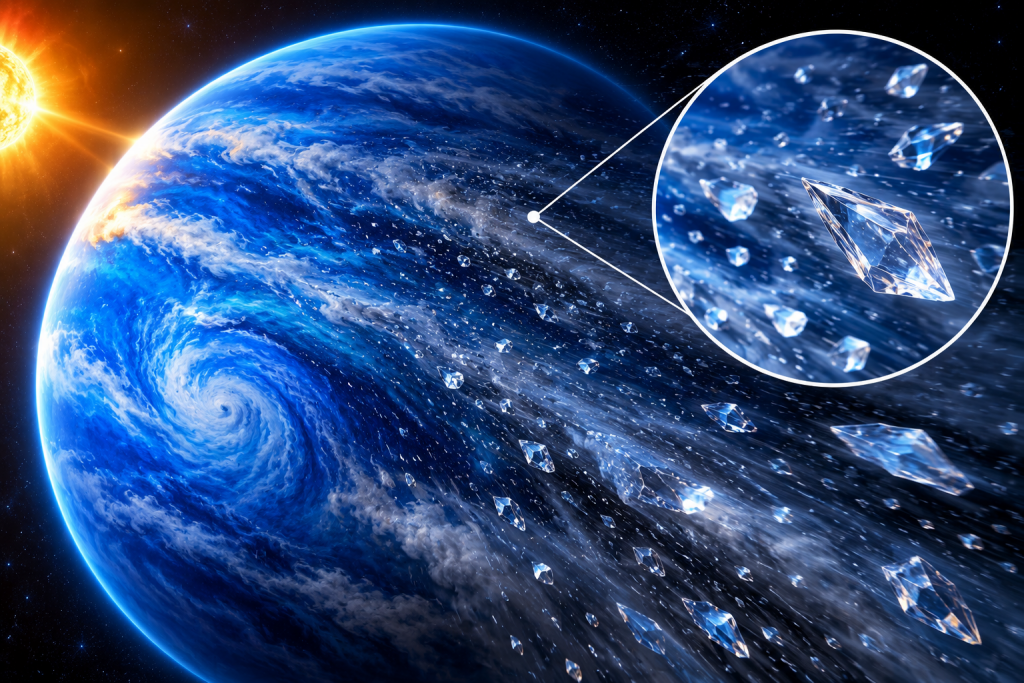
This Is Not The Kind Of Rain You Want To Stand In
About 64 light-years from Earth is a giant exoplanet called HD 189733 b.
From a distance, the planet has a beautiful deep-blue appearance.
But this is no peaceful blue world.
NASA describes HD 189733 b as a scorching gas giant where temperatures reach roughly 1,700 degrees Fahrenheit, or about 930 degrees Celsius.
And its weather may include something almost unimaginable.
Glass particles flying through the atmosphere in ferocious winds.
Why Is The Planet Blue?
When scientists first measured the visible-light color of HD 189733 b, they found that it would appear deep blue.
But the color does not come from oceans like Earth’s.
NASA says the blue color is probably caused by clouds containing silicate particles. Silicates are materials found in things such as sand and glass.
In the extreme heat of this planet’s atmosphere, silicate material can exist in tiny particles suspended high above the planet.
The Winds Are Incredible
HD 189733 b orbits extremely close to its star.
One trip around that star takes only about 2.2 Earth days.
The planet belongs to a class of worlds called hot Jupiters, enormous gas planets orbiting surprisingly close to their stars.
Conditions on HD 189733 b produce extreme atmospheric circulation.
NASA has described winds reaching speeds of around 4,500 miles per hour.
For comparison, even the strongest hurricanes on Earth have winds nowhere near that speed.
So Does Glass Literally Rain Sideways?
This famous description needs a little explanation.
You would not see windows or drinking glasses falling from the sky.
Scientists think silicate material can condense into tiny particles in the planet’s atmosphere.
Those particles could behave somewhat like glassy droplets or grains.
Combine them with winds thousands of miles per hour, and instead of falling gently downward, the particles could be blasted sideways through the atmosphere.
That is where the extraordinary description “raining glass sideways” comes from.
You Could Never Stand On It Anyway
Even without the glass, visiting HD 189733 b would present another enormous problem.
There probably is not a solid surface where a person could simply stand.
Like Jupiter, HD 189733 b is a gas giant.
As you descended into its atmosphere, pressure and temperature would increase dramatically.
Long before reaching anything resembling a conventional surface, the environment would become completely unsurvivable.
Astronomers Can Study A Planet They Cannot See Up Close
One of the most amazing parts of this story is how scientists learned any of this.
HD 189733 b is trillions of miles away.
No spacecraft has visited it.
Astronomers instead study the light associated with the planet and its star.
By examining how different wavelengths of light behave when the planet passes in front of or behind its star, scientists can learn about the planet’s atmosphere, temperature and even its color.
A tiny change in distant starlight can reveal the weather on another world.
A Beautiful Planet With Terrifying Weather
From far away, HD 189733 b might look inviting.
Its rich blue color could almost remind you of Earth.
But appearances can be wildly misleading.
There are no blue oceans beneath that color.
Instead, there is crushing pressure, tremendous heat, astonishing winds and an atmosphere containing silicate particles.
It may be one of the most beautiful examples of why you should never judge a planet by its color.
That gorgeous blue world may have glass flying sideways through its sky at thousands of miles per hour.
Sources: NASA Science, NASA Jet Propulsion Laboratory, and Hubble observations.