

A Day On Venus Is Longer Than A Year On Venus
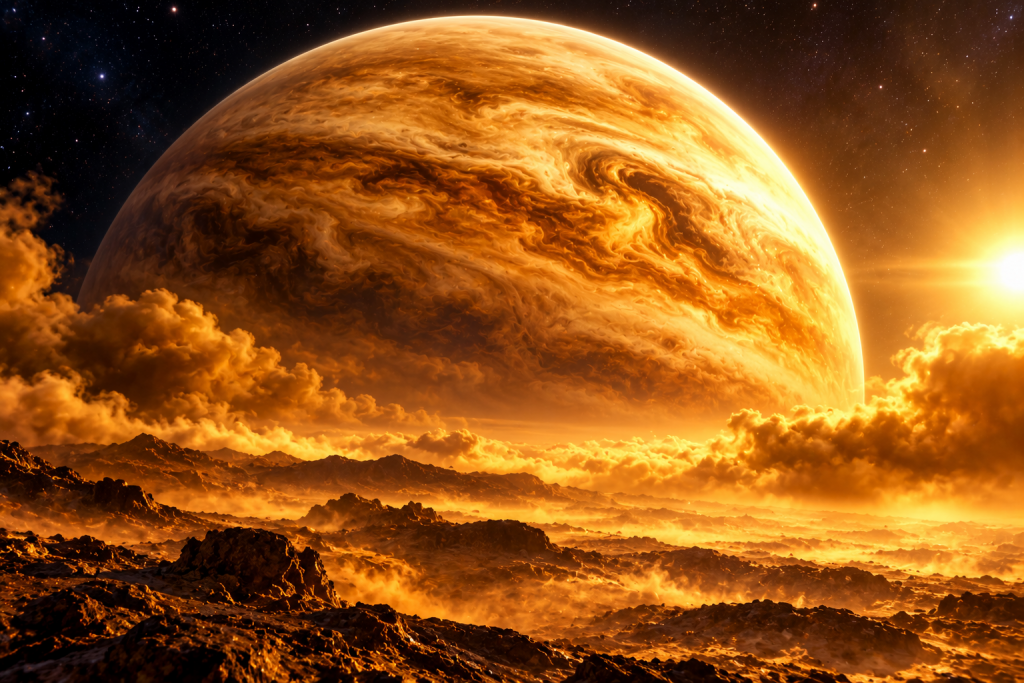
Time Gets Very Strange On Venus
Here on Earth, the idea is simple.
A day lasts about 24 hours.
A year lasts about 365 days.
Naturally, a year is much longer than a day.
Travel to Venus, however, and that familiar relationship gets turned upside down.
Venus takes about 243 Earth days to rotate once on its axis, but only about 225 Earth days to complete one orbit around the Sun. NASA Science
That means Venus completes an entire year before it finishes one full rotation.
Why Does Venus Turn So Slowly?
Venus rotates extraordinarily slowly compared with Earth.
Earth completes one rotation in roughly 24 hours. Venus needs about 243 Earth days.
Scientists know that Venus’s thick atmosphere interacts with the planet’s rotation, and researchers continue studying how atmospheric and other forces influence its spin.
Measurements have even found small variations in the exact length of Venus’s rotation. NASA Technical Reports Server
Whatever happened during the planet’s long history, Venus ended up with one of the strangest rotations in our solar system.
Venus Also Spins Backward
Things get even stranger.
Venus rotates in the opposite direction from Earth and most of the other planets.
This is called retrograde rotation.
If you could somehow stand safely on Venus and see through its thick clouds, the Sun would appear to rise in the west and set in the east. NASA Science
That is the reverse of what we experience on Earth.
But There Is Another Kind Of Day
Here is where planetary timekeeping becomes tricky.
Scientists can define a “day” in more than one way.
A sidereal day measures how long a planet takes to rotate once relative to distant stars. For Venus, that is about 243 Earth days.
A solar day measures the time from one sunrise to the next.
Because Venus is moving around the Sun while slowly rotating backward, one solar day on Venus lasts about 117 Earth days. NASA Science
So technically, the famous statement that a Venus day is longer than its year refers to its rotation period.
And even with that clarification, it is still astonishing.
You Would Wait Months For Sunrise
Imagine being able to stand on Venus.
Ignoring the fact that the surface is hot enough to melt lead and the atmospheric pressure would be crushing, the movement of the Sun would seem incredibly slow. Venus has an average surface temperature of roughly 462 degrees Celsius, or 864 degrees Fahrenheit. NASA Science
From one sunrise to the next would take about 117 Earth days.
Daylight itself would last for weeks.
Night would too.
A normal Earth calendar would become almost meaningless.
Venus Is Similar To Earth In Size, But Not Much Else
Venus is sometimes called Earth’s sister planet because the two worlds are relatively similar in size and mass.
But the resemblance quickly disappears when you look closer.
Venus has an atmosphere dominated by carbon dioxide, clouds containing sulfuric acid, extreme surface temperatures, enormous atmospheric pressure, and that incredibly slow backward rotation. NASA Science
It is a powerful reminder that two rocky planets of similar size can evolve into completely different worlds.
A Year Before The Planet Finishes Turning
On Earth, we experience hundreds of rotations during a single trip around the Sun.
Venus does not even finish one.
It travels all the way around the Sun in about 225 Earth days while requiring roughly 243 Earth days to complete a single rotation.
So somewhere next door in our solar system is a planet where the calendar can finish the year before the planet finishes its turn.
On Venus, even time seems to play by different rules.
Sources: NASA Science and NASA planetary data.